MEDIA ANALYSIS DESK — A shocking video capturing a dramatic emotional breakdown during a routine prenatal ultrasound appointment has recently taken social media by storm. The staged clip serves as an excellent case study in how scripted, sensationalist content is designed to trigger massive public engagement online.
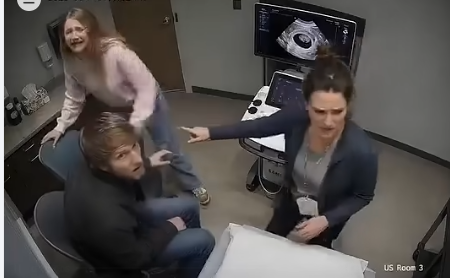
A highly dramatic video has recently generated intense discussion across platforms like TikTok and Facebook, racking up millions of views within a short timeframe. The security-camera-style footage depicts a young couple sitting inside a medical examination room during what appears to be a standard prenatal checkup. A female medical professional or sonographer is seen pointing toward a Samsung ultrasound monitor that displays a clear image of a developing fetus. The atmosphere changes instantly when the pregnant woman suddenly reacts with extreme horror, pointing at the monitor while screaming hysterically. She explicitly shouts, “No, no, no, I don’t want that baby!” multiple times before leaping out of her chair in a state of visible panic. Her partner sits momentarily frozen in sheer confusion before standing up to restrain and comfort her, while the medical technician actively steps backward to give the shouting woman space. This sudden burst of unprovoked aggression and fear creates a deeply unsettling scene that leaves viewers immediately questioning the psychological state of the mother. Because of the raw emotion displayed, thousands of internet users have actively shared the clip, debating whether the footage represents a real psychiatric emergency.
However, a thorough digital forensic and behavioral analysis of the clip reveals clear evidence that the entire scenario is completely staged. The overarching goal of this video is not to document a medical case, but rather to function as highly engineered ragebait or shock-value entertainment designed to capture fleeting online attention. A critical flaw in the video’s authenticity is discovered by closely examining the security camera timestamp printed at the top-left corner of the screen. The digital overlay displays the date as April 27, 2025, a timestamp that proves the video was deliberately pre-recorded, archived, and systematically distributed much later for maximum viral impact. Furthermore, the physical layout of the examination room, labeled neatly as “US Room 3” in the bottom-right corner, mimics a professional clinic but lacks essential medical protocols. The placement of the wide-angle camera is perfectly optimized to capture the facial expressions and body language of all three actors simultaneously. This precise framing is a hallmark of internet prank channels rather than an authentic, legally protected medical surveillance log.
From a behavioral perspective, the performances of the actors further expose the scripted nature of the encounter. The pregnant woman’s transition from calm conversation to high-pitched, explosive screaming happens too abruptly to match a genuine psychological trigger. Her physical gestures, such as placing her hands over her mouth and throwing herself backward, heavily resemble stylized theatrical acting rather than an authentic panic attack. The male partner’s delayed verbal reaction and his generic questioning of “Honey, what’s wrong?” feel forced and heavily rehearsed. Additionally, the medical professional fails to follow standard clinical crisis-management protocols when dealing with a seemingly unstable patient. Instead of attempting to medically de-escalate the situation or calling for immediate psychiatric assistance, she delivers a standard, scripted hand gesture toward the door. This superficial reaction confirms that the individual in the lab coat is an actor participating in a coordinated skit rather than a licensed medical worker.
Disinformation researchers point out that the ultrasound image displayed on the Samsung monitor is actually a static stock graphic. The black-and-white fetal image remains completely motionless on the screen, failing to show the real-time cardiac or bodily movements typical of a live sonogram. This indicates that the video creator simply loaded a generic pre-saved image file onto the screen to act as a physical prop for the actors. Content creators frequently use these familiar medical settings because pregnancy-related storylines naturally evoke powerful protective instincts and high emotional responses from global audiences. By creating a narrative where a mother seemingly rejects her unborn child, the producers successfully guarantee an avalanche of negative comments and fierce debates in the engagement section. This specific type of content thrives on social media algorithms, which automatically boost videos that generate high volumes of user arguments and prolonged watch times. Regrettably, many casual internet users mistake these highly orchestrated performances for real-world events, leading to unnecessary social commentary regarding modern parental mental health.
Media literacy organizations are utilizing this exact video to educate the public on the booming industry of scripted social media dramas. Modern content creators frequently establish fictional companies or use mock sets to produce hundreds of similar dramatic simulations every month. These videos are legally permitted under the guise of entertainment, yet they rarely feature clear “parody” or “dramatization” disclaimers on the actual video overlay. This deliberate omission allows the content to masquerade as leaked real-life footage, successfully deceiving millions of unsuspecting scrolling users. Verifying the authenticity of online media requires viewers to look past initial emotional shocks and critically analyze structural inconsistencies, such as static monitors and theatrical acting. As video production tools and generative media continue to advance, discerning reality from digital theater becomes a vital skill for internet consumers. Ultimately, this viral ultrasound breakdown stands as a definitive reminder that online content is frequently engineered for corporate ad revenue rather than factual documentation.