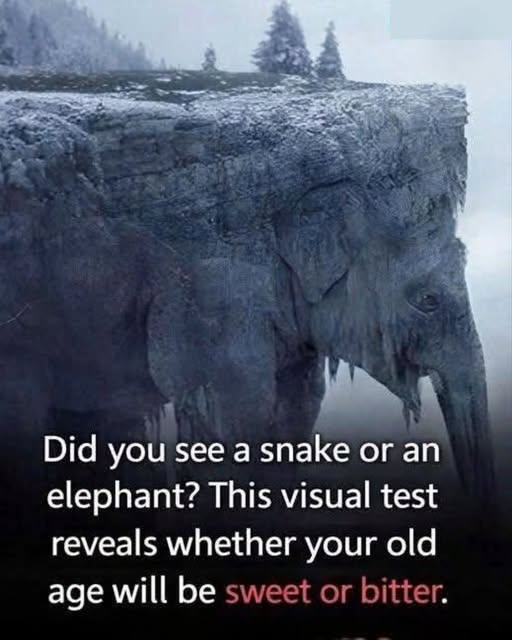
What this viral illusion truly exposes is not whether you are a “snake person” or an elephant person,” but how astonishingly personal reality can be. Your brain is not a camera recording an objective world; it is an active storyteller, a master editor working behind the scenes. In a split second, before you are even consciously aware of it, your mind chooses what to highlight, what to ignore, and how to turn scattered, ambiguous shapes into something meaningful, familiar, and safe enough to understand. It takes the chaotic raw data of the world and constructs a narrative that fits your internal architecture.
When you argue over what you saw first, you are not actually debating the pixels on the screen. Instead, you are revealing the unique lens through which your mind tends to approach the world. One person immediately catches the sharp, winding curve of the snake—a hyper-vigilant, detail-driven response that prioritizes immediate, isolated elements. Another person absorbs the broad, sweeping silhouette of the elephant—a big-picture focus that seeks context and stability before examining the parts. Neither way is wrong, and neither is an error in perception. Both are proof of a brain working at incredible speed, executing a highly sophisticated cognitive dance guided by your personal history, subconscious memories, latent emotions, and unspoken expectations.
Ultimately, these optical tricks do more than just entertain us for a fleeting moment on social media. They pull back the curtain on the fragility of human certainty. The illusion becomes a quiet, profound reminder: if we can look at the exact same arrangement of lines and lines, on the exact same screen, and still fiercely disagree about a single picture, imagine how gently we should hold our conclusions about everything else. If our physical sight is this subjective, then our perspectives on politics, relationships, morality, and truth are bound to be infinitely more complex. Embracing this doesn’t mean discarding our views, but rather approaching the views of others with a renewed sense of curiosity and humility.