An interesting piece of dashcam footage capturing a seemingly ordinary moment on an American highway recently exploded in popularity across various social media platforms. The video features a close-up perspective of the rear of a moving silver SUV navigating a congested multi-lane freeway during what appears to be late afternoon or early evening traffic. What instantly caught the attention of motorists and millions of internet users alike was not the vehicle itself, but a bold, handwritten political statement prominently displayed across its entire back windshield. Written in stark white lettering, the message reads, “This is AMERICA… We Don’t REDISTRIBUTE,” accompanied by a smaller scribbled acronym below it that appears to read “AMERC.” This specific viral SUV windshield message quickly transformed from a simple highway sighting into a massive lightning rod for political commentary, cultural memes, and intense digital debate after being shared online.
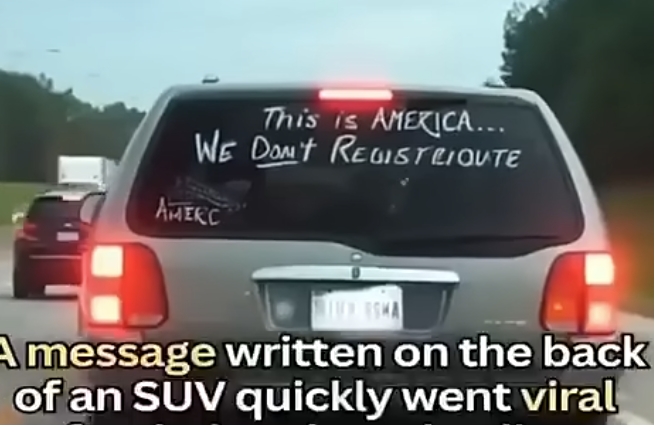
As the short video clip progresses, the camera remains focused on the back of the SUV as the flow of traffic fluctuates, causing the vehicle’s bright red brake lights to illuminate repeatedly. This repetitive visual rhythm somehow amplifies the tension surrounding the written message, drawing the viewer’s eye back to the bold declaration against economic redistribution. The footage perfectly captures a modern phenomena where personal vehicles are utilized as moving billboards for political expression, transforming daily commutes into public forums. Within hours of being uploaded to major platforms like Reddit, the clip garnered thousands of views, shares, and subsequent discussions. The immediate fascination with this anti-redistribution highway message highlights how deeply polarized and reactive online audiences have become to overt political expressions in everyday public spaces.
Decoding the Visual Elements and Political Symbolism of the Footage
To fully understand why this brief video triggered such a massive wave of online interaction, one must look closely at the specific composition and wording chosen by the vehicle’s owner. The phrase written on the glass leverages powerful nationalistic rhetoric by starting with a definitive declaration of identity, asserting a specific interpretation of what American values should entail. By capitalizing the words “AMERICA” and “REDISTRIBUTE,” the driver deliberately emphasizes their core philosophical stance, drawing a hard line against socialist policies or government-mandated wealth distribution. This type of political expression on vehicles serves as a direct reflection of broader grassroots conservative sentiments that prioritize individual liberty and free-market capitalism above collective economic leveling. The addition of the messy, shorthand acronym at the bottom further suggests a deeply personalized, urgent desire to communicate these beliefs to anyone driving behind them.
The cinematic quality of the video, despite being recorded from what looks like a standard dashboard camera or a passenger’s mobile phone, adds an authentic, raw layer to the narrative. The viewer feels as if they are stuck in that exact same traffic jam, forced to contemplate the driver’s philosophical message while navigating the mundane realities of a congested highway. The surrounding environment, characterized by an overcast sky, dense green trees lining the highway borders, and a steady stream of neighboring vehicles, creates a relatable backdrop for the unfolding digital drama. This contrast between the ordinary act of driving and the heavy ideological weight of the written text is precisely what makes the viral traffic video analysis so compelling for cultural commentators. It illustrates how public infrastructure, designed simply to move citizens from one point to another, frequently becomes a stage for ideological signaling and social friction.
How the Internet Reacted to the Anti-Redistribution Statement
The real magic of any viral piece of content lies in the comment section, and this specific video generated an absolute goldmine of witty responses, intense debates, and satirical takedowns. While a portion of the online audience applauded the driver’s bold stance and expressed agreement with the underlying capitalistic sentiment, the overwhelming majority of highly upvoted comments took a decidedly ironic turn. Netizens quickly pointed out the immense structural irony embedded within the entire scene, noting that the driver was utilizing a massive system of public highways to spread their message. Because public roads, law enforcement traffic control, and highway maintenance are entirely funded through collective taxpayer dollars, critics argued that the driver was actively benefiting from a form of wealth redistribution while protesting it. This glaring contradiction became the central theme of the social media backlash to viral SUV, sparking endless threads detailing the nuances of democratic socialism versus public utility funding.
Beyond the philosophical debates regarding tax structures and infrastructure, the internet community did what it does best by finding the ultimate comedic angle to diffuse the tension. Drivers who frequently navigate heavy traffic immediately shifted the focus from politics to highway etiquette, analyzing the SUV’s lane positioning within the video context. A popular satirical consensus emerged suggesting that the driver was likely hogging the fast lane or failing to adhere to standard merging rules, prompting users to joke that the driver was refusing to “redistribute” the lane space to faster vehicles. This brilliant pivot from heavy political theory to universally relatable driving frustrations showcased the internet’s unique ability to commodify serious cultural friction into digestible, humorous memes. Ultimately, this trending highway politics video serves as a fascinating case study on how a simple, handwritten message on a dusty car window can ripple across the digital landscape, reflecting the complex, often contradictory nature of modern social discourse.