Hurricane Barbara continues its trajectory. Where is it and where is it headed? Hurricane Barbara maintains sustained winds of 120 km/h and gusts of up to 150 km/h, enough to damage structures and cause power outages.
Credit: SMN
Hurricane Barbara is now making its presence felt off the Pacific coast of Mexico. Having strengthened into a Category 1 hurricane, it is moving rapidly northwest, leaving torrential rains, violent winds, and rough seas in its wake across the states of Jalisco, Colima, Michoacán, and Nayarit.
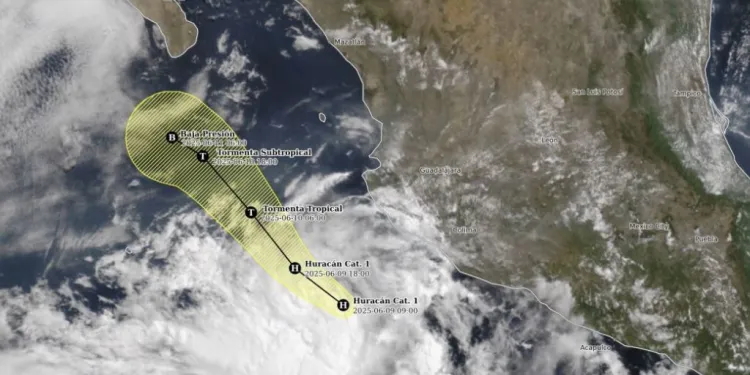
This Monday, June 9, 2025, the National Meteorological Service (SMN) and the US National Hurricane Center confirmed that Barbara has reached hurricane status, with sustained winds of 120 km/h and gusts of up to 150 km/h, a speed sufficient to knock down trees, damage light structures and cause power outages.
At 3:00 PM Central Time, the center of Tropical Storm Barbara was located 230 kilometers southwest of Playa Pérula, Jalisco, and 280 kilometers west-southwest of Manzanillo, Colima, moving northwest at 17 km/h. Its trajectory keeps it relatively close to land, which increases the risk to coastal communities.
Fierce waves and dangerous rainfall
The hurricane’s cloud bands are widespread, generating very heavy rainfall in Jalisco, Colima, and Michoacán (25 to 50 mm), as well as showers in Nayarit (5 to 25 mm). This rainfall may lead to landslides, overflowing rivers and streams, and flooding in low-lying areas.

Credit: X
The wind is also picking up. Gusts of up to 80 km/h are being recorded along the coasts of Jalisco and Colima, and gusts of up to 60 km/h in Michoacán and Nayarit. This is accompanied by dangerous waves of 3.5 to 4.5 meters in Jalisco, Colima, and Michoacán, and up to 2.5 meters in Nayarit.
Experts emphasize the seriousness of these conditions. The sudden increase in river flow, combined with soil saturation from previous rainfall, poses a real threat to both rural and urban communities.

Credit: Civil Protection on alert: Don’t let your guard down
Mexican authorities urge the public to follow official announcements from the National Meteorological Service (SMN) and Civil Protection, and to stay away from beaches, mountainous areas, and bodies of water that could overflow.
Although Hurricane Barbara has not yet made landfall, its proximity is enough to create high-risk conditions throughout the central-western region of the country. Temporary shelters have been activated in several coastal towns, and residents are advised to prepare emergency kits, identify evacuation routes, and avoid unnecessary travel.

Credit: X What’s happening with Tropical Storm Cosme?
Meanwhile, another threat lurks in the ocean: Tropical Storm Cosme, located about 975 kilometers south-southwest of Cabo San Lucas, Baja California Sur, with sustained winds of 110 km/h and moving northwest. Despite its strength, Cosme does not pose a direct threat to Mexico due to its distance, although its development continues to be monitored.
You may be interested in > Tropical Storm Barbara becomes a hurricane: Torrential rains and high waves in these states

Credit: SMNBárbara is a warning: Climate change intensifies hurricanes
The 2025 Pacific hurricane season is already showing its strength, and Barbara is just the beginning. According to meteorological experts, the warming of ocean waters, exacerbated by climate change, is leading to more frequent, intense, and destructive hurricanes.
A magnitude 9.1 earthquake also caused a tsunami in the city of… See more
A magnitude 9.1 earthquake also caused a tsunami in the city of… See more
The biggest earthquake in 140 years hits Japan: a nation on high alert
Tokyo, Japan – Japan has been struck by its most powerful earthquake in 140 years, leaving a trail of destruction, anguish, and a nation in a state of emergency. The 8.9 magnitude quake struck early Tuesday morning, with its epicenter in the sea off the northeast coast of the country, near Miyagi Prefecture.
The tremor, which lasted more than a minute, caused entire buildings to sway violently in Tokyo, more than 300 kilometers from the epicenter. Seismic alarms sounded across the country, allowing many people to evacuate in time, but it was not enough to prevent the tragedy.
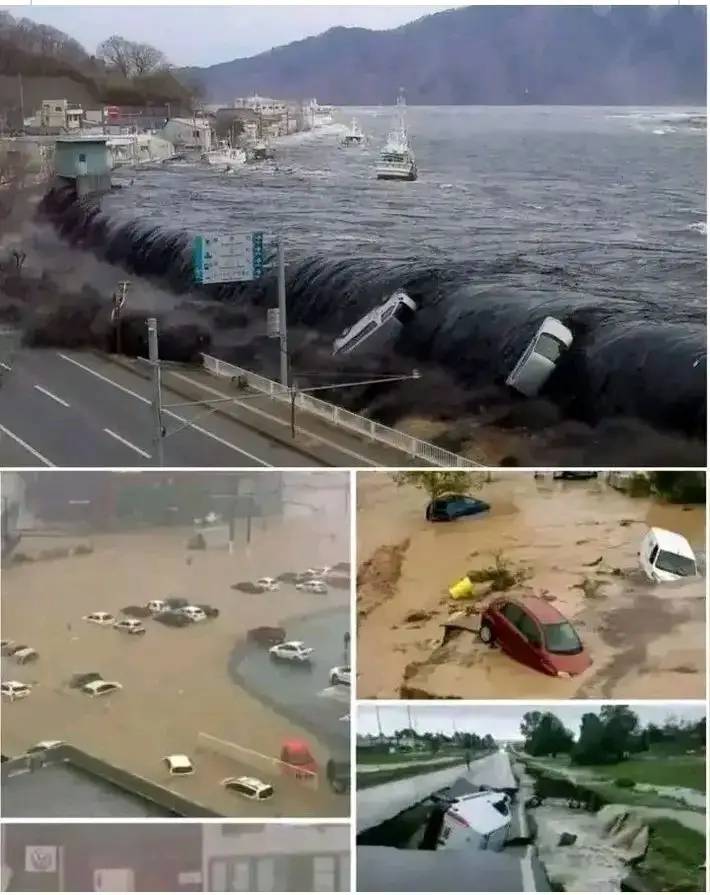
So far, authorities have confirmed more than 3,000 deaths and thousands of missing persons. Aerial images show coastal cities completely devastated by a tsunami following the earthquake, with waves over 10 meters high sweeping homes, cars, and boats inland.
In an emergency press conference, Japan’s Prime Minister declared a national state of emergency and called for calm. “This is a disaster of historic proportions. But Japan has risen again before, and it will again,” he stated resolutely.
Hospitals in the affected areas are overwhelmed, and thousands have sought refuge in makeshift shelters. More than 1.5 million homes are without power, and food, water, and basic necessities are scarce. Self-defense forces, along with international rescue teams, are working tirelessly to find survivors trapped under the rubble.
One of the biggest fears following the earthquake is the situation at several nuclear power plants in the region. In particular, the Fukushima plant has reported serious damage to its cooling systems, triggering a global alarm over a possible radioactive leak. Authorities have evacuated a 20-kilometer radius around the plant and are constantly monitoring radiation levels.
Seismology experts have described this event as the worst since the Great Kanto Earthquake of 1923 and the strongest recorded since modern scientific records began. According to the Geological Research Institute of Japan, the energy released by this earthquake is equivalent to hundreds of atomic bombs like the one dropped on Hiroshima.
The international community has responded quickly, sending humanitarian aid, rescue teams, and technical support. Countries such as the United States, South Korea, Germany, and Mexico have shown their solidarity with the Japanese people.
Meanwhile, the Japanese are once again demonstrating their resilience, discipline, and solidarity. Despite the devastation, hundreds of volunteers have organized to help those most in need, and donation centers are receiving support from all over the country.
This tragic event marks a turning point in modern Japanese history. Reconstruction will take years, but the indomitable spirit of the Japanese people has already begun to flourish amidst the ruins.